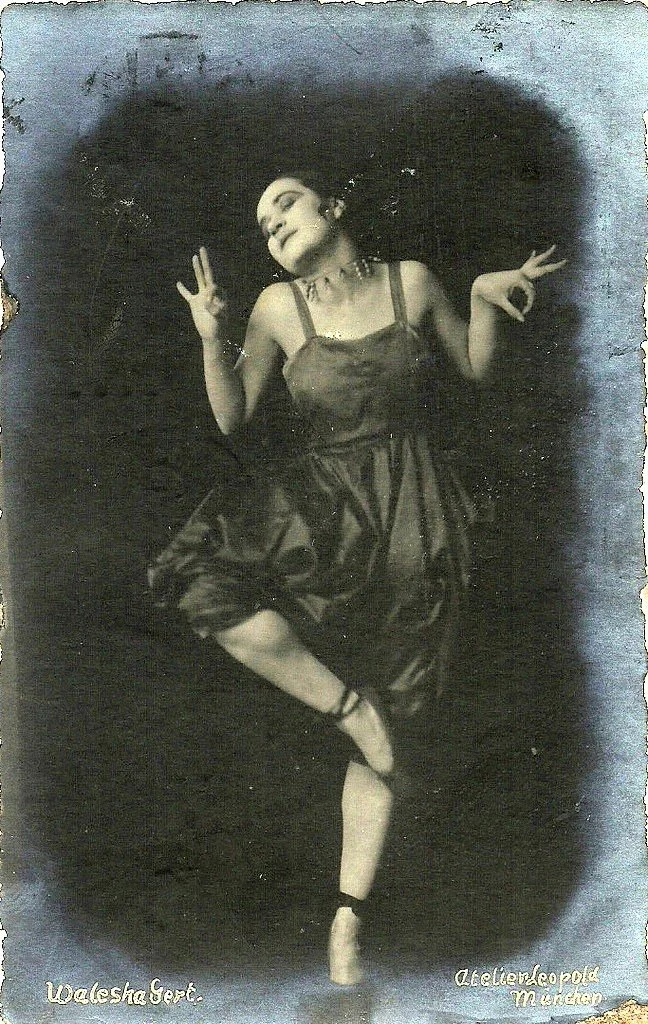
Valeska Gert, “Dance in Orange,” Atelier Leopold, Munich, 1918. Wikimedia Commons
6 November 2026
Born in 1892 in Berlin, Valeska Gert realized early in her life that she had to dance to feel alive. Growing up in a Jewish bourgeois family, she didn’t feel she belonged at school and decided to attend dance school instead, hoping to perform on stage one day. Her first solo dance “Tanz in Orange” (1918) was a revolution. She oscillated between moments of wildness and sweetness, swinging her arms like a pendulum while contorting her face into grimaces. This is what she imagined dance to be like: a fusion of dance, facial expression, sound, language and theatre into one whole.
This was the birth of modern dance satire, a genre to which Valeska Gert would make an important contribution. She made visible what normally was not seen on stage - movements of everyday life combined with the fantastical and grotesque into an abstract dance. She wanted to depict people of her time and danced what others didn’t want to dance. She even claimed to have invented happenings. When the Dadaists held a matinee in Berlin, showing a race between a sewing machine and a typewriter, Valeska danced to the sounds of the two machines, holding two pounds of recently bought asparagus in her arms.
In 1932, Valeska Gert opened her first cabaret - “Kohlkopp” (Cabbage Head) - in Berlin. At this venue, she could freely express what she wanted: she could be radical, bizarre and break the taboos of her times. But with Hitler´s rise to power in 1933, her art was branded degenerate and it became more and more difficult for her to perform. In 1939, she emigrated to the USA where she had to start from scratch. In 1941, she opened the “Beggar´s Bar” in New York’s Greenwich Village. The avant-garde cabaret soon became famous for providing an experimental space for theatre, performance and dance. Tennessee Williams, who went on to shape American drama, worked as a waiter and busboy at the “Beggar’s Bar”. Returning to Europe in 1947, she continued her artistic life, acted in movies for Federico Fellini and settled down on the German island Sylt, where she opened her last venue, “Ziegenstall”.
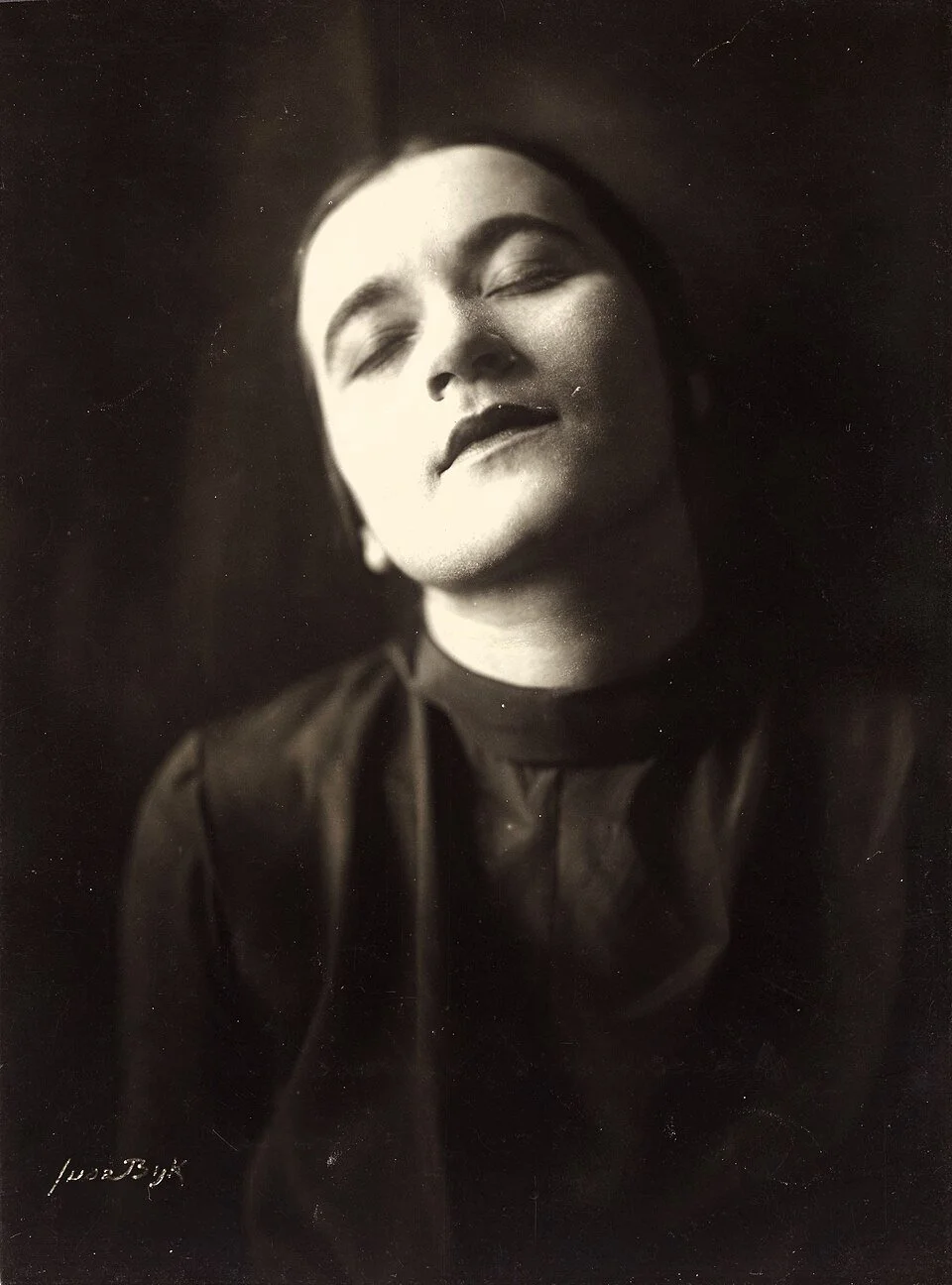
Valeska Gert, photo by Suse Byk, 1923-1925. Wikimedia Commons
Valeska Gert was a personality of her time. Always ready to take risks, her dances were playful, challenging, ruffling feathers while entertaining her audience. She fused dance, facial expression, sound, language and theatre into one whole. In the words of Fred Hildenbrandt, Valeska was a wild firecracker, wrapped in bright colours, making a hellish racket, with shards flying everywhere. And in the end, no one can say for certain whether Valeska Gert was a highly original dancer expressing the undercurrents of her time, or whether she wasn’t a dancer at all. In her autobiography Ich bin eine Hexe, she describes how her dance “Canaille” played with the ways in which female sexuality was perceived at that time: “Defiantly, I sway my hips, lift my black, very short skirt, revealing white thigh flesh above long black silk stockings and high-heeled shoes. I am a sensual whore, moving gently and voluptuously.”
Her dance expressed her own sexual alienation, while at the same time conveying a social critique.